
Re-envisioning the Game of Life
Have you ever played Hasbro’s board game, Life? If you have, you may (or may not) have noticed that there are implicit assumptions about what a “successful” life looks like.
Just in case you have forgotten how the game is played, or you have never played it, here is a summary.
As the game begins, players select a blue or pink peg to represent themselves. Then select from two “paths” in life – the college track or the career track. As players move through the game board, they encounter various life events – paydays, real estate transactions, career advancements, and stock market changes. There are also three required “stop” spaces – choosing a final career, buying a house, and getting married. The game ends when all players reach the retirement space. After all assets are liquidated, the winner is declared the player with the highest net worth.
This game is a cultural artifact, designed very intentionally to reinforce certain social choices and wealth acquisition as keys to success (without acknowledging a much more complicated context and set of working conditions). In the traditional game of Life, only some lives and pathways (and by extension, perspectives) are seen as “valuable”, which echoes much of our lived experience. How does this narrow view limit our financial, social, and creative potential?
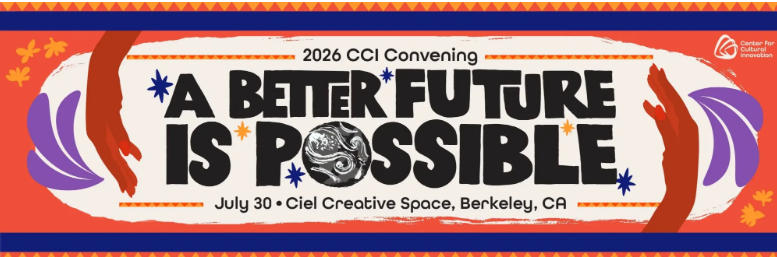
The Center for Cultural Innovation, through our AmbitioUS initiative, has been exploring culturally rooted community ownership as an alternative pathway (often building on ancestral wisdom) to the game of life. At CCI’s “A Better Future is Possible Convening” in July 2026, the AmbitioUS team wanted to provide a way for groups of people who are working together to build new economic, social, and cultural systems (we call them world-builders) to reflect on the traditional societal norms and systems in which we currently operate, while also envisioning a new, better future. To engage participants in that conversation, we created an event focused on interaction, experiential learning, and exploration. What would it look like to make a new game of life for mutualistic well-being?
At our July convening, we held a solidarity fair celebrating the many efforts across the United States that prioritize collectivization through culturally-rooted community ownership and governance. And in the afternoon, inspired by the book Beautiful Solutions: A Toolbox for Liberation (released in 2025), which is a collectively-sourced guidebook that highlights real-world grassroots alternatives and community-led systems to transform economic and social systems, we held a design workshop where participants grappled with hypothetical situations (based on real-life challenges) and practiced building community-driven systems together.
Working with subject matter experts from Beautiful Trouble (the companion book to Beautiful Solutions) to design the workshop and one of their skilled facilitators, participants were invited to choose a topic area to focus on – Land and Housing, Health and Care, Finance, and Energy and Utilities. Each sector had a scenario. For example, the group focused on energy and utilities were presented with a scenario where a well-known data center was looking to locate one of its major facilities in the town. The community was split on whether it should advocate to house the facility or reject it. The group was challenged to design a beautiful solution that centered environmental, labor, and safety priorities.
Working in small groups, participants were instructed to use the principles and values from the Beautiful Solutions book to develop creative responses to their community challenge that prioritized collectivism and mutual well-being. They presented their ideas to each other for feedback and fine-tuning.
At the end of the convening, each of the four sectors shared the community challenge and an idea (or compilation of ideas) of a solution with the broader community. What was striking about all the solutions presented was their creativity and their holistic nature. It was a reminder that communities already have what they need to design and implement systems that take into consideration the needs of people and planet.
Crystal Huang, of OAKTree Initiative, described her experience, “The Design Workshop let me experience democracy as a living process where many small groups worked the same challenge side by side, and witnessed how our collective ideas coalesced into one shared solution for each topic that belonged to all of us.” OAKTree is a nonprofit that designs block-scale networks of shared thermal energy, closed-cycle greenhouses, and the skills and local jobs to run them. Crystal also participated in the Solidarity Fair and said of the Convening, “I left grateful to CCI for filling a room with people ready to move from being stuck in the problem to visioning what is possible.”
The game of life is being reimagined by OAKTree and others. And while the solutions may be “beautiful”, participants reminded us of how challenging, messy, tenuous, and still how necessary it is for us to build together. Beautiful Solutions reminds us that we are not alone in imagining an economy that allows us to be in the right relationship with the planet and each other. We plan to continue our partnership with Beautiful Solutions to share more real-world examples from movement-builders across the country and to design more interactive opportunities for newcomers to engage with concepts of mutuality and cooperativism.
Together, we are not just envisioning a better future; we are actively building it.
This article was originally published on Medium. Read it on Medium →
